A robot that can move through a building changes what tasks can be automated. It can carry goods, inspect equipment, or bring supplies to a person without staying fixed to one work area.
That matters because many jobs include repeated travel. The work may be picking, checking, cleaning, or moving parts, yet people still spend time walking between locations.
Quick read
- Mobility lets one robot cover several work areas instead of staying beside one machine.
- Sensors and mapping help a robot move around people, shelves, doors, and other obstacles.
- The useful measure is the task completed, not the distance traveled.
Movement is often the hidden task
A fixed robot can repeat the same motion with high consistency. Its reach is tied to its position, so the surrounding process must bring each item to that work area.
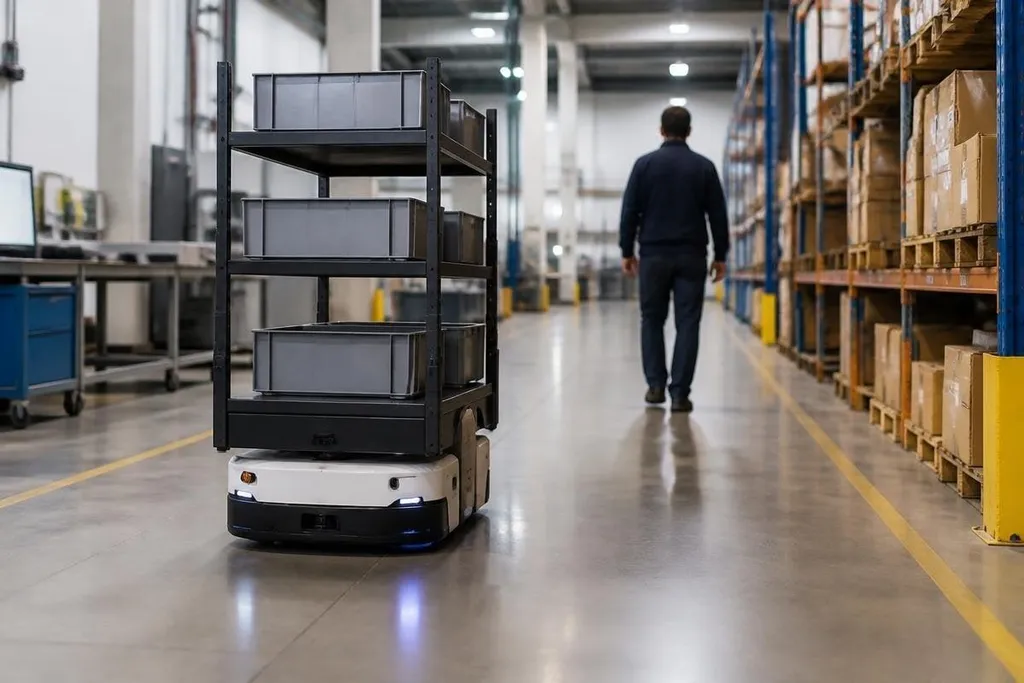
Mobility changes that layout. An autonomous mobile robot, or AMR, uses wheels, sensors, and software to move through a defined space. It can carry a load to a workstation, collect a finished item, then return for another task.
That movement can remove small trips that add up across a shift. The value depends on the route, the load, the floor, and how often people or equipment block the path. A robot that moves quickly but waits at doors has solved less than its speed suggests.
Where mobility helps
Warehouses are a clear example. An AMR can move totes between storage areas and picking stations, while staff stay near the work that needs judgment or hand control. The result depends on how the robot fits into the existing layout and software.
Hospitals and laboratories have different needs. In those settings, a mobile platform may carry samples, meals, or supplies between rooms. That can reduce routine transport, but doors, lifts, hygiene rules, and handoffs still shape the job.
Outdoor machines face another set of problems. Farm robots, inspection platforms, and delivery machines must deal with uneven ground, weather, changing light, and objects that were absent from their maps. A system built for a smooth indoor floor cannot be judged by the same test.
A farm robot that loses traction on wet soil may stop the task even when its arm and camera work as planned. Robot24 can connect those movement limits to the job, site, and test result, so the report shows what the machine can do outside a lab.
The hard parts are physical
Moving through a known room is easier than moving through a busy public area. The robot must estimate its position, detect objects, choose a safe route, and stop when the scene changes.
This is where sensors and software meet the limits of the machine. Poor light can reduce the useful detail in a camera image. LiDAR, which measures distance with laser pulses, can detect nearby shapes but still needs software to decide what they mean. Wheel slip can also make the robot’s position estimate less accurate.
The handoff creates another weak point. The platform may reach the correct shelf yet fail to place a box where a person or another machine can take it. Good mobility ends with a usable delivery, not with arrival at a coordinate.
I’d judge a mobility robot by the number of complete tasks it can finish with normal human traffic around it. A smooth demonstration says less than a repeatable route, a safe stop, and a handoff that works each time.
Check the job before buying
Use this short decision guide before choosing a mobile platform:
- Map the route: record doors, lifts, narrow turns, floor changes, and areas where people gather.
- Count the trips: measure how often the task repeats and how far each load must travel.
- Check the payload: include the container, tools, and any fixture the robot must carry.
- Test the handoff: confirm where the load goes and what happens when the receiving station is busy.
- Plan recovery: assign a person and a process for blocked paths, low batteries, lost maps, and faults.
- Set a result: track completed jobs, waiting time, safety stops, and staff time moved to other work.
Mobility robots are becoming more useful as automation moves beyond fixed work cells. Their value rests on reliable movement joined to a complete task. Each site should ask which repeated trip is worth removing first.